Chapter 4.4 – Transformers and Modern Architectures
A thinking-out-loud, engineer-focused guide to transformers and modern deep learning architectures, with practical analogies and real-world lessons.
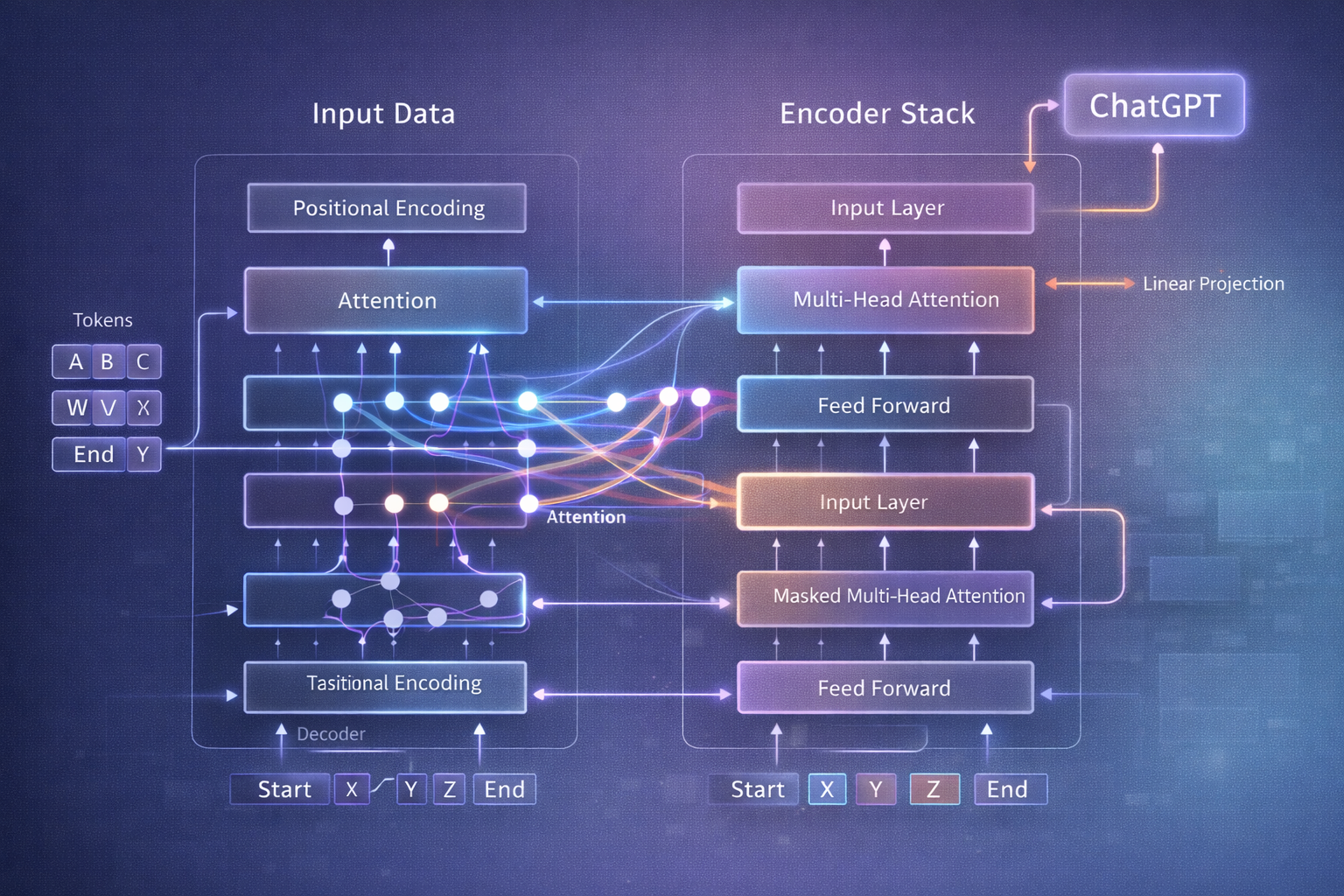
Transformers and Modern Architectures: Thinking Out Loud
Introduction
When I first heard about transformers, I honestly thought:
“Another architecture? Didn’t CNNs and RNNs already solve this?”
What I didn’t realize yet was that transformers weren’t just another model — they were a structural shift, the same way container orchestration changed infrastructure.
Not better scripts.
Not faster pipelines.
A different mental model.
Once that clicked, modern AI finally started making sense.
1. Why Transformers Exist
Before transformers:
- RNNs processed sequences step-by-step → slow, forgetful, hard to scale
- CNNs worked well for images → awkward for language and long context
The core problem wasn’t accuracy.
It was memory and parallelism.
Transformers solved both:
- They see the entire input at once
- They decide what matters dynamically
- They train efficiently on massive datasets
Engineer’s Insight: Transformers are to deep learning what Kubernetes is to infrastructure—scalable, flexible, and a bit intimidating at first.
2. The Attention Mechanism: The Secret Sauce
The real innovation wasn’t layers or neurons.
It was attention.
Instead of processing tokens sequentially, transformers ask:
“Which parts of this input matter most to this prediction — right now?”
Analogy: Incident Investigation
Imagine debugging an outage:
- You don’t read logs line-by-line from midnight
- You jump straight to correlated signals
- You focus where the system feels wrong
That’s attention.
Transformer Workflow:
flowchart LR
    Input[Input Sequence] --> Embedding[Embedding Layer]
    Embedding --> Attention[Self-Attention Layer]
    Attention --> FFN[Feed Forward Layer]
    FFN --> Output[Prediction]
    style Input fill:#e3f2fd,stroke:#1976d2,stroke-width:2px
    style Embedding fill:#fff3e0,stroke:#f57c00,stroke-width:2px
    style Attention fill:#f3e5f5,stroke:#7b1fa2,stroke-width:2px
    style FFN fill:#e8f5e9,stroke:#388e3c,stroke-width:2px
    style Output fill:#e8f5e9,stroke:#388e3c,stroke-width:2px
Every token can reference every other token — instantly. No memory decay. No scanning. No bottleneck.
Key Use Cases:
- Language modeling (GPT, BERT, LLMs)
- Code generation and understanding
- Time series with complex dependencies
Automation Analogy: Attention is like a smart log analyzer that instantly finds the most relevant events, no matter how big the log file is.
3. Transformers vs. CNNs & RNNs
| Architecture | Best At | Limitation |
|---|---|---|
| CNN | Images, spatial data | Not good for sequences |
| RNN | Sequences, time series | Slow, forgets long-term context |
| Transformer | Language, code, long sequences | Needs lots of data & compute |
What changed everything:
- Transformers process everything in parallel
- Context is global, not local
- Training scales across massive clusters
This is why:
- LLMs exist
- Code models exist
- Chatbots stopped feeling brittle
4. Where Transformers Actually Shine (Engineering View)
Example 1: Intelligent Change & Deployment Risk Assessment (Transformer)
- Scenario: Predict the risk of a deployment request (code or infrastructure change) before it happens, using all available context.
- Input:
- Change type (e.g., IaC, config)
- Environment (prod, staging, dev)
- Resource count
- Time (peak/off-hours)
- Team
- Historical incidents and outcomes
- How a Transformer Helps:
- Attends to all features and their interactions, not just recent or local context
- Can weigh the importance of, say, deploying to prod during peak hours with a large change, even if those signals are far apart in the input
- Learns complex risk patterns from historical data
- Output:
- Risk level (e.g., High, Medium, Low)
- Confidence score
- Recommendation (e.g., manual review, auto-approve)
Example 2: Automated Incident Summarization (Transformer)
- Input: Sequence of log events from a major outage
- Transformer attends to the most critical events
- Output: Concise summary for the engineering team
Example 3: Code Review Automation (Transformer)
- Input: Entire code diff
- Transformer highlights risky changes, suggests improvements
- Output: Actionable review comments
5. Common Pitfalls and How to Avoid Them
- Pitfall 1: Using transformers for small/simple problems
- Fix: Use simpler models when possible—transformers shine on big, complex data
- Pitfall 2: Underestimating compute needs
- Fix: Plan for GPU/TPU resources, or use pre-trained models
- Pitfall 3: Ignoring data quality
- Fix: Garbage in, garbage out—clean data is still king
Warning: Transformers are powerful, but not magic. The basics (good data, clear problem definition) still matter most.
6. What I Wish I Knew Earlier
Takeaway:
- Transformers are the backbone of modern AI
- Attention lets models focus on what matters
- Parallel processing = speed and scale
- Start simple, scale up as needed
“From Automation to AI – A Practitioner’s Journey: Series 4 - Deep Learning (Demystified) Recap
Series 4 Recap:
- Chapter 4.1: Why Deep Learning Exists – Why classic ML hits a wall and deep learning is needed for complex, messy problems.
- Chapter 4.2: Neural Networks Explained Like Infrastructure – How neural nets work, with analogies for engineers and automation pros.
- Chapter 4.3: Deep Learning Architectures: CNNs, RNNs & Practical Examples – When to use CNNs vs RNNs, and how to avoid common pitfalls.
- Chapter 4.4: Transformers and Modern Architectures – The leap to attention, parallelism, and the foundation of modern AI (LLMs, GPT, BERT).
What’s Next: From Automation to AI – A Practitioner’s Journey: Series 5 – Generative AI & LLMs
Understanding how ChatGPT and similar models work.
🚧 Chapter 5.1 – What Is Generative AI (Coming Soon)
- Predicting the next token
- Why ChatGPT works
- Generative vs discriminative models
🚧 Chapter 5.2 – How LLMs Are Trained (High Level) (Coming Soon)
- Pre-training on massive datasets
- Fine-tuning for specific tasks
- RLHF (Reinforcement Learning from Human Feedback)
🚧 Chapter 5.3 – Prompt Engineering for Engineers (Coming Soon)
- Prompts as interfaces
- Deterministic vs probabilistic outputs
- Best practices for working with LLMs