Chapter 5.0 – Generative AI & LLM Roadmap
How the core ideas of Generative AI and LLMs fit together, and how each chapter in Series 5 builds your skills from concepts to real-world automation.
Why This Chapter Exists
By the time I reached Generative AI and LLMs, I’d already seen a lot of hype—and a lot of confusion. Some people treated LLMs like magic; others dismissed them as toys. What was missing was a clear, engineer-friendly map of how all the pieces fit together.
Series 5 is that bridge: it takes you from “What is Generative AI?” all the way to prompt engineering, tokens/context windows, and production-grade orchestration.
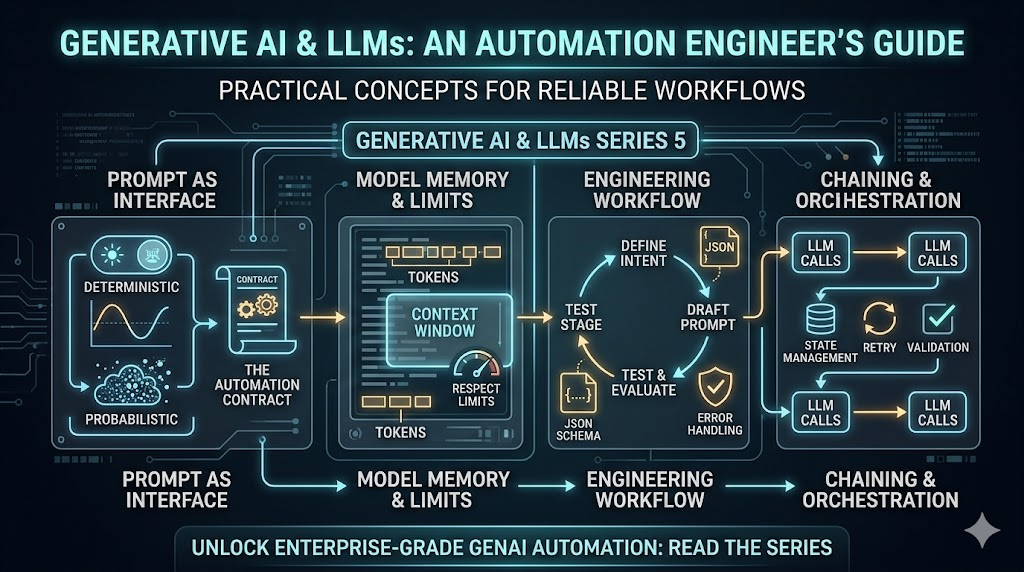
This chapter is your roadmap for Series 5: a quick way to see how each chapter connects, and how the whole series helps you build reliable LLM-powered automation.
How to use this chapter:
Treat this as a navigation guide. If you’re new to Generative AI, start with 5.1 and move forward. If you’re already hands-on with LLMs, you can jump directly into prompt engineering or orchestration and come back here whenever you need the bigger picture.
The Generative AI & LLM Journey (Series 5 Roadmap)
| Generative AI / LLM Pillar | Series 5 Chapter & Link |
|---|---|
| What Generative AI Really Is | 5.1 – What Is Generative AI? |
| How LLMs Are Trained | 5.2 – How Large Language Models Are Trained (High Level) |
| Prompt Engineering Fundamentals | 5.3 – Prompt Engineering for Engineers |
| Prompt Engineering in Practice | 5.4 – Prompt Engineering in Practice: Workflow & Effective Patterns |
| Tokens & Context Windows | 5.5 – Tokens, Context Windows, and Why Prompts Matter |
| Chaining & Orchestration | 5.6 – Advanced Prompt Chaining and Orchestration (with real-world automation patterns and series wrap-up) |
Use this table as a reference point:
- When you’re unsure which chapter to read next
- When you want to quickly revisit a specific concept
- When you’re mapping these ideas into your own automation landscape
How Series 5 Builds on Earlier Series
Context Reminder:
- Series 0–2 gave you the foundations: why AI matters, how ML works, and how data, features, and training fit together.
- Series 3 showed you the end-to-end ML workflow.
- Series 4 demystified deep learning and transformers—the backbone of modern LLMs.
Series 5 assumes that context and focuses on a practitioner view of Generative AI and LLMs:
- Chapter 5.1 explains what generative AI actually is and why it feels different from classic ML.
- Chapter 5.2 gives you a high-level mental model of how LLMs are trained, so their behavior (and quirks) make sense.
- Chapters 5.3 and 5.4 turn LLMs into practical tools via prompt engineering workflows and patterns.
- Chapter 5.5 teaches you to respect tokens and context windows so your prompts don’t silently break.
- Chapter 5.6 shows how to chain and orchestrate prompts into production-ready automation, with real-world patterns.
By the end of Series 5, LLMs stop being a black box—and become another powerful (but opinionated) component in your automation toolkit.
Where to Start (Based on Who You Are)
New to Generative AI / ChatGPT:
Start at Chapter 5.1, then 5.2 → 5.3 → 5.5 → 5.4 → 5.6.Already using ChatGPT, but ad-hoc:
Start at Chapter 5.3 (Prompt Engineering for Engineers), then 5.4 → 5.5 → 5.6. Come back to 5.1–5.2 when you want deeper intuition.Automation / Platform engineer building LLM workflows:
Skim 5.1–5.2, then focus on 5.3–5.6 (prompt design, tokens/context windows, chaining, orchestration, and patterns).
What’s Next
This roadmap is your starting point for Series 5. As you work through the chapters, use it to stay oriented and to connect each concept back to the bigger picture:
- How does this chapter change the way I design prompts or workflows?
- How does it help me build more reliable, testable automation?
- Where can I apply this tomorrow in my real environment?
When you’re ready, jump into Chapter 5.1 – What Is Generative AI and start the next part of the journey.