Chapter 4.3 – Deep Learning Architectures: CNNs, RNNs & Practical Examples
A practical, engineer-focused guide to core deep learning architectures (CNNs, RNNs), their use cases, and pitfalls—explained with automation analogies.
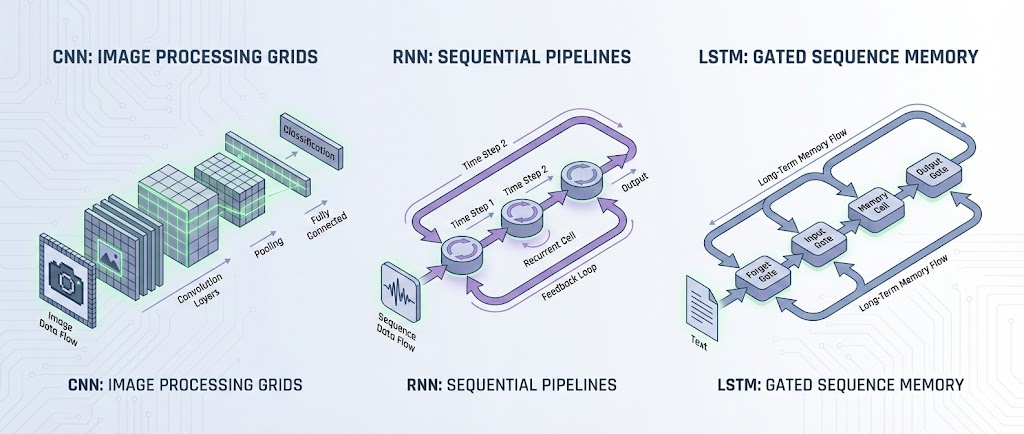
Deep Learning Architectures: CNNs, RNNs & Practical Examples
TL;DR
TL;DR:
- CNNs are best for images and spatial data; RNNs are best for sequences and time series.
- The right architecture saves time and headaches—match your tool to your data and problem.
- Practical engineering analogies make deep learning architectures easier to grasp for automation and DevOps professionals.
- Avoid using advanced architectures when a simple rule or classic ML model will do.
Introduction
Building on our neural network fundamentals, this chapter explores the most important deep learning architectures—Convolutional Neural Networks (CNNs) and Recurrent Neural Networks (RNNs)—with practical, automation-inspired analogies for engineers.
Engineer’s Insight: Choosing the right architecture is like picking the right automation tool—each is optimized for a specific type of problem.
1. Why Architectures Matter
- Not all neural networks are created equal
- The structure (architecture) determines what problems a network can solve
- Like using Terraform for infra and Ansible for config, you need the right tool for the job
Architect’s Question: What makes one neural network architecture better suited for images, and another for sequences?
2. Convolutional Neural Networks (CNNs): The Image Specialists
Analogy: Automated Quality Control in Manufacturing
- Imagine a conveyor belt with cameras at each stage
- Each camera checks for specific defects (scratches, color, shape)
- The system learns to spot issues by scanning small regions, then combining results for the whole product
CNNs work the same way:
- They scan small patches of an image (convolutions)
- Detect local features (edges, corners, textures)
- Combine these to recognize complex patterns (faces, objects)
CNN Workflow:
flowchart LR
    Input[Input Image] --> Conv[Convolution Layer]
    Conv --> Pool[Pooling Layer]
    Pool --> FC[Fully Connected Layer]
    FC --> Output[Prediction]
    style Input fill:#e3f2fd,stroke:#1976d2,stroke-width:2px
    style Conv fill:#fff3e0,stroke:#f57c00,stroke-width:2px
    style Pool fill:#f3e5f5,stroke:#7b1fa2,stroke-width:2px
    style FC fill:#e8f5e9,stroke:#388e3c,stroke-width:2px
    style Output fill:#e8f5e9,stroke:#388e3c,stroke-width:2px
Key Use Cases:
- Image classification (cats vs dogs)
- Object detection (find all cars in a photo)
- Anomaly detection in visual data (manufacturing defects, medical scans)
Automation Analogy: CNNs are like automated visual inspectors—each layer specializes in finding certain features, and together they deliver a final decision.
3. Recurrent Neural Networks (RNNs): The Sequence Experts
Analogy: Automated Log Analysis
- Imagine a system that reads logs line by line, remembering what happened before
- It can spot patterns that unfold over time (e.g., a failed login followed by a password reset)
- The system’s memory lets it connect events across the sequence
RNNs work the same way:
- They process data one step at a time, passing information forward
- Maintain a hidden state (memory) of what’s happened so far
- Ideal for time series, text, and any sequential data
RNN Workflow:
flowchart LR
    Input[Input Sequence] --> RNN[RNN Layer]
    RNN --> Output[Prediction]
    style Input fill:#e3f2fd,stroke:#1976d2,stroke-width:2px
    style RNN fill:#fff3e0,stroke:#f57c00,stroke-width:2px
    style Output fill:#e8f5e9,stroke:#388e3c,stroke-width:2px
Key Use Cases:
- Time series forecasting (resource usage, stock prices)
- Natural language processing (text generation, translation)
- Event sequence prediction (anomaly detection in logs)
Automation Analogy: RNNs are like log analyzers with memory—they connect the dots across time, not just in a single snapshot.
4. Practical Examples for Engineers
Example 1: Predicting Deployment Failures from Metrics (CNN)
- Input: Heatmap of resource usage over time (visualized as an image)
- CNN scans for patterns that precede failures
- Output: Predicts risk of failure before deployment
Example 2: Detecting Anomalies in Log Sequences (RNN)
- Input: Sequence of log events from a deployment
- RNN learns normal event patterns
- Output: Flags unusual sequences that may indicate a problem
5. Common Pitfalls and How to Avoid Them
- Pitfall 1: Using CNNs for sequential data (logs, time series)
- Fix: Use RNNs or Transformers for sequences
- Pitfall 2: Ignoring data preprocessing (garbage in, garbage out)
- Fix: Clean and normalize your data
- Pitfall 3: Overfitting (model memorizes, doesn’t generalize)
- Fix: Use regularization, dropout, and validation sets
Warning: The most advanced architecture can’t fix bad data or the wrong problem framing.
6. What I Wish I Knew Earlier
Takeaway:
- CNNs are best for images and spatial data
- RNNs are best for sequences and time series
- The right architecture saves time and headaches
- Always match your tool to your data and problem
What’s Next?
➡ Series 4 – Chapter 4.4: Transformers and Modern Architectures
In the next chapter, we’ll explore:
- Transformers: the architecture behind modern AI (LLMs, GPT, BERT)
- How transformers differ from CNNs and RNNs
- Why transformers are so powerful for language and sequence tasks
- Practical engineering examples and pitfalls
Architectural Question: What makes transformers so effective for language and sequence data, and how can engineers leverage them in real-world systems?
You now have a practical foundation in deep learning architectures. Next, we’ll tackle the models powering today’s AI revolution.