Chapter 0.2 – My Background and Learning Strategy: Approaching AI as a Solution Architect
How a solution architect approaches learning AI, and why the traditional data scientist path may not fit. Part of the 'From Automation to AI' series.
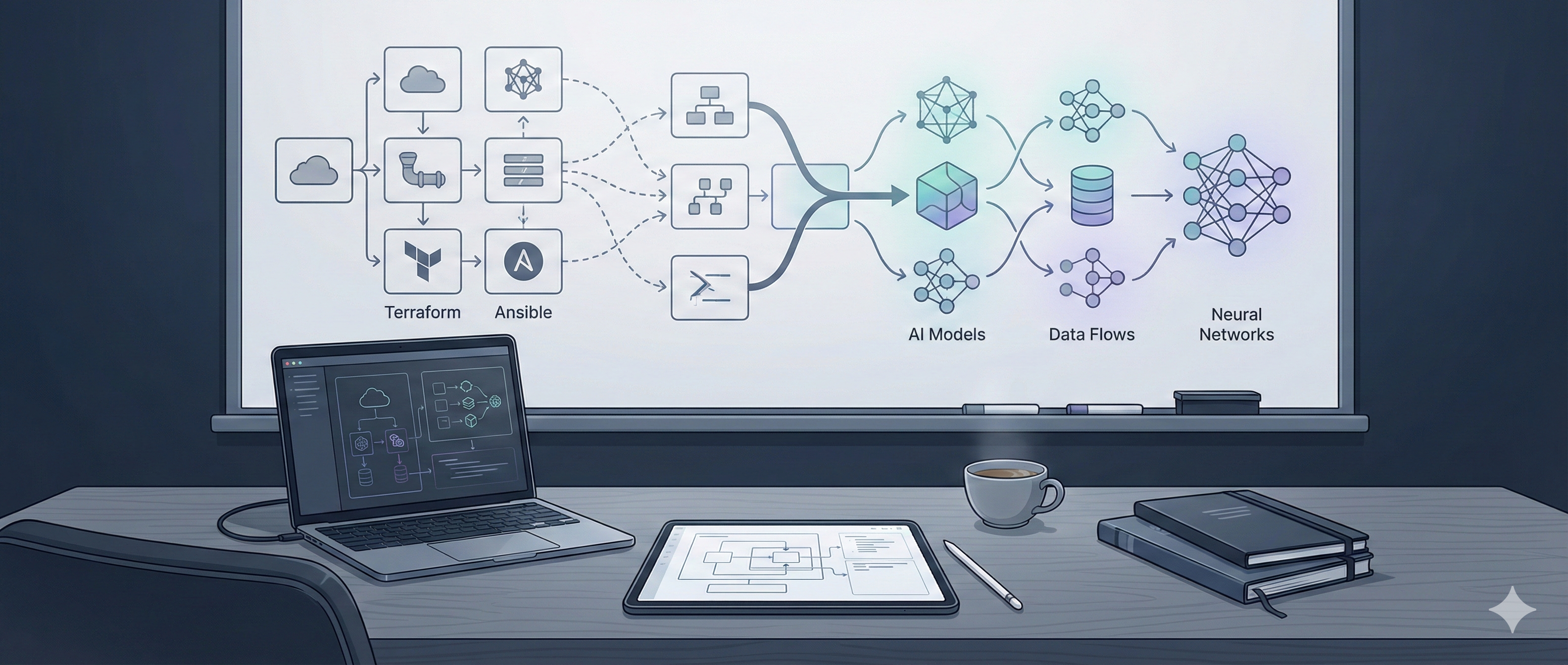
My Background and Learning Strategy
(Why I’m Learning AI the Way I Am)
Before diving into ML concepts, here’s the context for how I’m approaching this learning:
- Where I’m coming from professionally
- Why I’m not following the traditional “data scientist” learning path
- How this series aligns with real-world platform design
AI is automation’s natural evolution, not its replacement.
1. My Background: Automation to Architecture
My career has been centered around designing, solutioning, and implementing platforms, not isolated tools.
Automation Foundations
I started where most ops engineers do: writing scripts to avoid repetitive work.
- Bash scripts for deployments
- Scheduled jobs for backups
- Rule-based workflows
- Anything to reduce manual toil
Engineer Insight: The mindset was simple: If humans repeat it, automate it.
Infrastructure as Code (Terraform / Ansible)
IaC changed everything. Suddenly automation had structure:
- Desired state over imperative scripts
- Version-controlled infrastructure
- Repeatability across environments
Terraform and Ansible taught me:
- State awareness
- Idempotency (run it 100 times, same result)
- Separating intent from execution
I didn’t realize it then, but this thinking maps directly to how AI systems define goals and learn to achieve them.
CI/CD and DevOps Frameworks
Pipelines added feedback loops:
- Continuous testing and validation
- Policy enforcement at every stage
- Automated rollback on failure
The big lesson: Systems improve through feedback, not static rules.
That’s the foundation of machine learning.
CMPs and Self-Service Platforms
As a Solution Architect, I started building Cloud Management Platforms at scale:
- Self-service catalogs
- Governance through guardrails
- Standardization across teams
This is where static rules hit a wall.
Not all users behave the same.
Not all workloads carry the same risk.
Not all changes need the same approval flow.
I found myself writing increasingly complex conditional logic that still couldn’t adapt to context.
Static rules felt… insufficient.
2. The Architectural Progression
Looking at this journey end-to-end, the progression is clear:
1
2
3
4
5
6
7
8
9
Automation
    ↓
Infrastructure as Code
    ↓
CI/CD Pipelines
    ↓
Self-Service Platforms (CMPs)
    ↓
Intelligent Decision-Making
Key insight: AI is not a disruption in this flow—it is the next logical architectural capability.
3. Why I’m NOT Taking the “Data Scientist” Path
Most AI content assumes you want to become a data scientist:
- Math-heavy foundations
- Algorithm optimization
- Model research and tuning
That’s not my goal. I don’t need to invent new models—I need to know when and how to use existing ones in production systems.
4. The Solution Architect’s Objective
My questions are different:
- Where does AI fit in system architecture?
- When is AI appropriate vs overkill?
- How do I integrate AI with DevOps, IaC, and CMPs?
- How do I make AI systems governable and auditable in production?
I need to apply AI responsibly at scale, not invent it.
5. How I’ll Learn AI in This Series
My approach: Concepts → Intuition → Examples
Concepts First
What it is, why it exists, what problem it solves. No equations. No framework deep-dives.
Build Intuition
Mental models using automation and IaC analogies. If you can reason about it, you can design with it.
Practical Examples
Real-world use cases. Platform implications. Where AI fits in DevOps and CMP workflows.
Goal: Decision-making clarity, not implementation trivia.
6. What This Series Skips
To stay focused on architecture, I’m intentionally avoiding:
- Deep mathematical derivations
- Academic ML proofs
- Model tuning details
- Framework-specific tutorials
Those are valuable—but they distract from system design.
7. Who This Is For
You, if you already think in terms of:
- Pipelines and state
- Guardrails and governance
- Scale and operability
Specifically:
- Solution architects
- Platform engineers
- DevOps and IaC practitioners
- Anyone building self-service platforms
What I Wish I Knew Earlier
Practitioner’s Lessons:
- AI is the next step in the automation-to-architecture evolution
- Focus: architectural understanding, not academic depth
- Approach: concepts → intuition → examples
- Goal: design AI-enabled systems, not build ML algorithms
What’s Next?
➡ Series 1 – Chapter 1.1: What Is AI (Really)?
In the next chapter, we’ll establish clear definitions for:
- AI vs ML vs Deep Learning
- Common misconceptions
- Why clarity is critical before going deeper