Series Introduction – From Automation to AI: A Practitioner's Journey
Landing page and introduction for the 'From Automation to AI' series. What to expect, who it's for, and how to navigate.
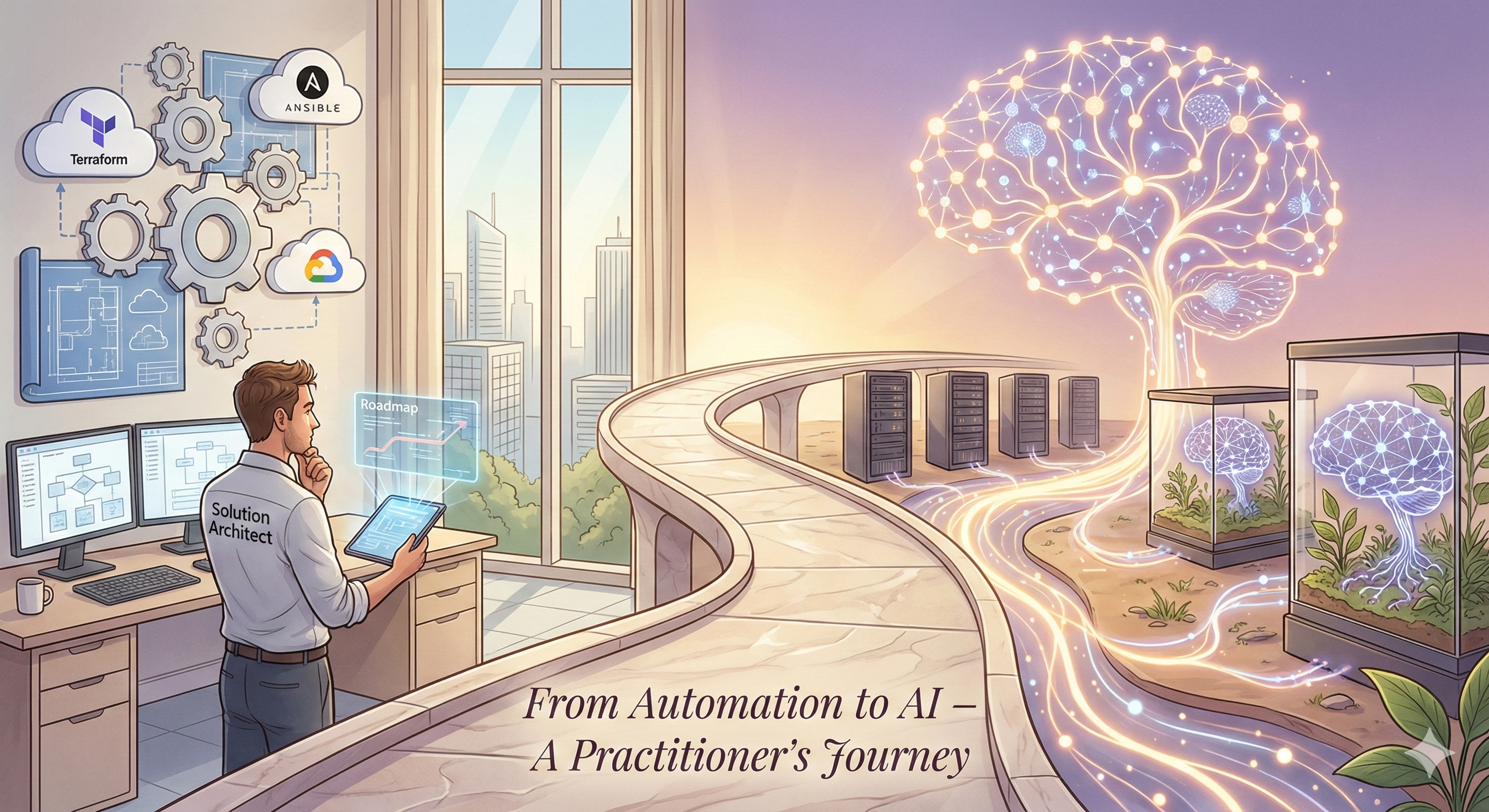
From Automation to AI – A Practitioner’s Journey
This series documents my journey of learning Artificial Intelligence from the perspective of a Solution Architect working on:
- Automation frameworks
- Infrastructure as Code (Terraform / Ansible)
- DevOps and CI/CD platforms
- Cloud Management Platforms (CMPs) and self-service catalogs
The goal is not to become a data scientist.
The goal is to understand:
- Where AI fits in modern architectures
- How AI complements automation and IaC
- How to design, integrate, and govern AI-enabled platforms
This is a learning journal and a practical reference—written for my future self and for engineers walking a similar path.
Who This Series Is For
This series is intended for:
- Solution architects
- Automation and platform engineers
- DevOps and IaC practitioners
- Engineers building self-service or CMP platforms
If you already work with:
- Pipelines
- Desired state
- Guardrails
- Scale and governance
You are the intended audience.
Series 0 – Foundations & Mindset
This introductory series sets the context, motivation, and learning strategy.
✅ Chapter 0.1 – Why Automation Engineers Should Learn AI
- Automation vs AI
- Where rule-based systems reach their limits
- How AI naturally augments IaC and CI/CD
✅ Chapter 0.2 – My Background & Learning Strategy
- Automation → Terraform → CI/CD → CMPs
- Why not the data scientist path
- How this series approaches AI learning
Series 1 – AI Fundamentals
This series establishes clear definitions before going deeper.
✅ Chapter 1.1 – What Is AI (Really)?
- AI vs ML vs Deep Learning, without hype
- Common myths and misconceptions
- Real examples: Auto-scaling (rule-based) vs ML-based scaling
- Where AI fits in modern architectures
✅ Chapter 1.2 – How Machines Learn
- Learning vs programming (core mental shift)
- Training data, features, and labels explained
- What “learning” actually means for machines
- Automation vs ML comparison with real examples
- Running example: Intelligent Change & Deployment Risk Assessment
✅ Chapter 1.3 – Types of Machine Learning
- Supervised, Unsupervised, Semi-Supervised, and Reinforcement learning
- When to use each approach
- Practical decision framework with running example
Series 2 – Machine Learning Basics (Practitioner View)
Understanding ML from an engineering perspective: data preparation, model training, and inference in production systems.
✅ Chapter 2.1 – Data: The New Configuration File
- Data as input, output, and state
- Bad data = bad model (garbage variables = broken infra)
- Data quality checklist: completeness, accuracy, consistency
- Training vs validation vs test sets
- Feature engineering basics
- Data bias and how to detect it
- Practical automation-inspired guidelines
✅ Chapter 2.2 – Features, Labels, and Models
- What is a feature? (Input variables)
- What is a label? (Expected output)
- What is a model? (The learned logic)
- Mapping to automation: Inputs → Logic → Outputs
- Feature engineering techniques
- Common pitfalls and how to avoid them
- Practical automation-inspired guidelines
✅ Chapter 2.3 – Model Training vs Execution
- Training ≠ inference (build time vs runtime)
- One-time vs continuous learning
- Terraform analogy:
terraform applyvs runtime behavior - Model artifacts and deployment
- When models need retraining
- Data drift and concept drift
- Retraining strategies and triggers
Series 3 – Core ML Concepts (Without Heavy Math)
Understanding machine learning algorithms and model behavior from a practical perspective.
✅ Chapter 3.0 – The ML Project Workflow
- Putting it all together: problem to production
- The seven phases of ML projects
- Mapping to automation workflows
- How all previous concepts connect
- Complete end-to-end example
✅ Chapter 3.1 – Common ML Algorithms (Intuition Only)
- Linear Regression, Decision Trees, Random Forest, KNN, and more
- Focus: When to use and why they work (not equations)
✅ Chapter 3.2 – Overfitting & Underfitting
- “Works in dev, fails in prod” analogy
- Why models fail in production
- Balancing model complexity
✅ Chapter 3.3 – Model Evaluation
- Accuracy, precision, recall (intuition)
- Why accuracy alone is misleading
- Choosing the right metrics
✅ Chapter 3.4 – Feature Engineering
- Transforming raw data into useful features
- Where 80% of ML work happens
Series 4 – Deep Learning (Demystified)
Understanding neural networks and deep learning from an infrastructure perspective.
✅ Chapter 4.0 – Deep Learning Roadmap
- Overview of deep learning concepts and applications
✅ Chapter 4.1 – Why Deep Learning Exists
- Limits of traditional ML
- Problems suited for deep learning: images, text, speech
- When to consider deep learning
✅ Chapter 4.2 – Neural Networks Explained Like Infrastructure
- Neurons as processing units
- Layers as pipelines
- Weights as configuration values
- Backpropagation (conceptually)
✅ Chapter 4.3 – Deep Learning Architectures: CNNs, RNNs
- CNNs (Convolutional Neural Networks) for images
- RNNs / LSTM for sequences
- Transformers and modern AI architecture
✅ Chapter 4.4 – Transformers & Modern Architectures
- Transformers, attention mechanisms, and modern deep learning
Series 5 – Generative AI & LLMs
Practical Generative AI and LLM concepts from an automation engineer’s perspective, focused on using models reliably in real workflows.
✅ Chapter 5.1 – What Is Generative AI
- Predicting the next token
- Why ChatGPT works
- Generative vs discriminative models
✅ Chapter 5.2 – How LLMs Are Trained (High Level)
- Pre-training on massive datasets
- Fine-tuning for specific tasks
- RLHF (Reinforcement Learning from Human Feedback)
✅ Chapter 5.3 – Prompt Engineering for Engineers
- Prompts as interfaces and contracts
- Deterministic vs probabilistic outputs
- Practical best practices for working with LLMs
✅ Chapter 5.4 – Prompt Engineering in Practice: Workflow & Effective Patterns
- End-to-end prompt engineering workflow
- JSON schemas, validation, and error handling
- Real scenario: AWS multi-region landing zone RFP response generator
✅ Chapter 5.5 – Tokens, Context Windows, and Why Prompts Matter
- Tokens and context windows explained
- How prompt structure affects what the model “remembers”
- Designing prompts that respect model limits
✅ Chapter 5.6 – Advanced Prompt Chaining and Orchestration
- Chaining prompts into reliable multi-step workflows
- Orchestrating LLM calls with state, retries, and validation
- Real-world automation patterns and series-level wrap-up
How to Read This Series
You can:
- Read sequentially from Series 0 onward
- Jump directly to a topic of interest
- Use it as a reference when designing platforms
Each chapter is written to stand on its own, while still fitting into the larger journey.
Closing Note
This series is intentionally:
- Architecture-focused
- Concept-first
- Tool-agnostic
Think of it as: AI explained for people who already build automation platforms.