Chapter 1.1 – What Is AI (Really?)
Cutting through the hype to define what AI really means for automation engineers. Part of the 'From Automation to AI' series.
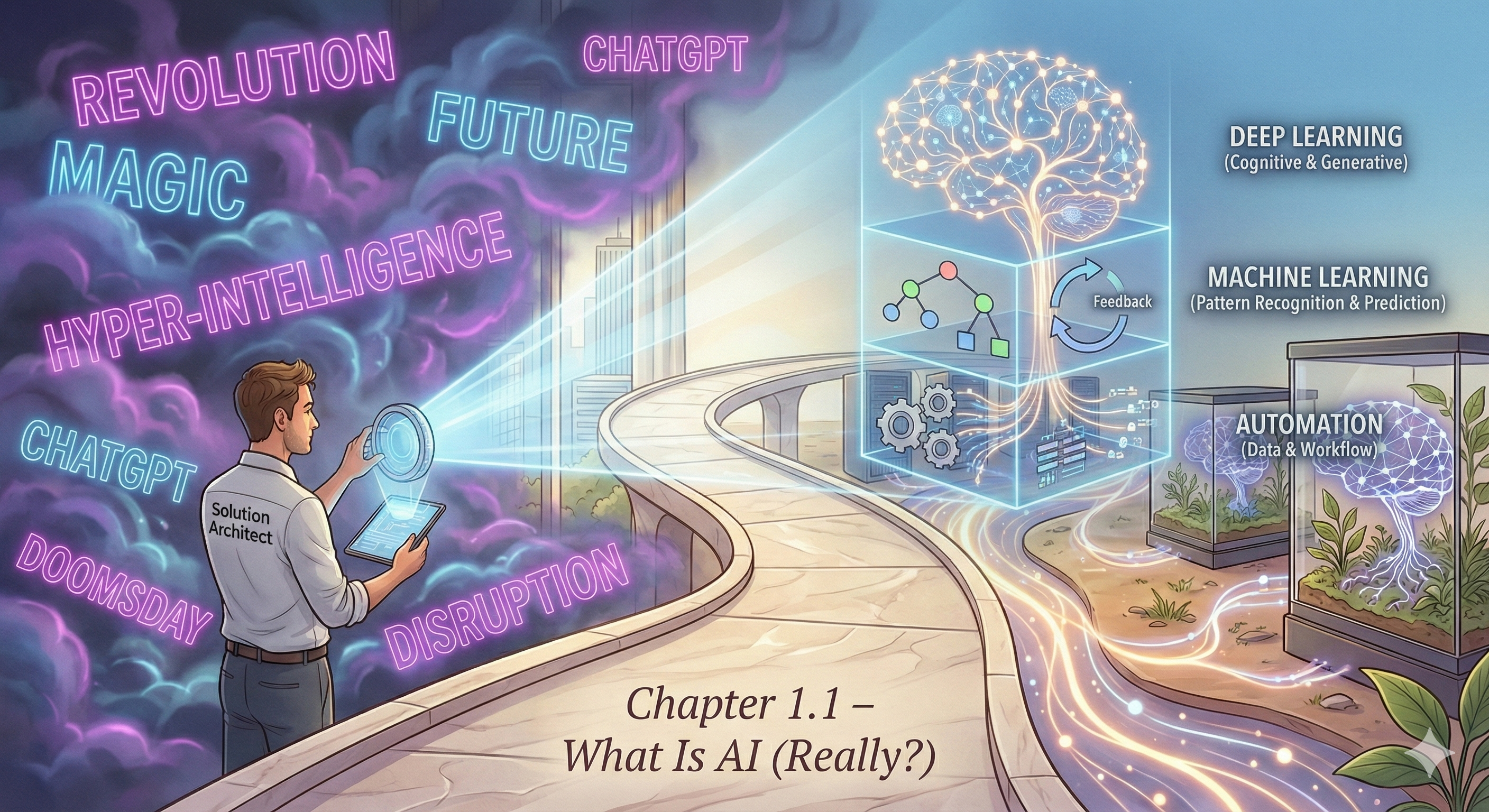
Cutting Through the AI Hype
Here’s an embarrassing confession: I spent months calling everything “AI” in architecture discussions.
- Complex approval logic? AI.
- Predictive scaling? AI.
- Simple if-then rules? Also AI, apparently.
Then someone asked: “Which kind of AI?” I had no answer.
Before we go deeper into ML, deep learning, or LLMs, let’s fix this:
Architect’s Question: What do we actually mean when we say “AI”?
Precision matters in architecture. Vague terms lead to bad decisions.
1. AI Is Not a Single Thing
AI is not one technology, tool, or model.
At a high level, AI refers to:
Definition: Systems that perform tasks which normally require human intelligence.
Examples include:
- Recognizing patterns
- Making predictions
- Understanding language
- Adapting behavior based on experience
This definition is intentionally broad—and that’s where confusion starts.
2. AI vs Automation – Clearing the Confusion
A common misconception is:
“If a system makes decisions, it must be AI.”
That is not true.
Automation
- Follows explicitly defined rules
- Behaves the same way every time
- Does not learn or adapt
Example:
1
2
IF request_type == "production"
THEN approval_required = true
This is decision logic, not intelligence.
Artificial Intelligence
- Learns patterns from data
- Makes probabilistic decisions
- Improves behavior based on experience
Example:
1
2
3
4
5
6
Based on:
- Past approval outcomes
- Change success rates
- Risk patterns

Predict whether approval is required
Key Difference
1
2
Automation → Executes known logic
AI          → Learns unknown patterns
Key Difference: Automation is deterministic. AI is adaptive.
Visually, the workflows look like this:
flowchart LR
    subgraph prog["Traditional Programming/Automation Workflow"]
        direction TB
        P1[Study Problem] --> P2[Write Rules]
        P2 --> P3{Test & Evaluate}
        P3 -->|Success| P4[Deploy]
        P3 -->|Failure| P5[Analyze Errors]
        P5 --> P2

        style P1 fill:#e3f2fd,stroke:#1976d2,stroke-width:2px
        style P2 fill:#fff3e0,stroke:#f57c00,stroke-width:2px
        style P3 fill:#f3e5f5,stroke:#7b1fa2,stroke-width:2px
        style P4 fill:#e8f5e9,stroke:#388e3c,stroke-width:2px
        style P5 fill:#ffebee,stroke:#d32f2f,stroke-width:2px
    end
    subgraph ml["Machine Learning Workflow"]
        direction TB
        M1[Collect Data] --> M2[Prepare & Label]
        M2 --> M3[Train Model]
        M3 --> M4{Evaluate Performance}
        M4 -->|Good Performance| M5[Deploy Model]
        M4 -->|Poor Performance| M6[Update Data/Features]
        M6 --> M2
        M5 -.->|Monitor & Retrain| M6

        style M1 fill:#e3f2fd,stroke:#1976d2,stroke-width:2px
        style M2 fill:#fff3e0,stroke:#f57c00,stroke-width:2px
        style M3 fill:#f3e5f5,stroke:#7b1fa2,stroke-width:2px
        style M4 fill:#f3e5f5,stroke:#7b1fa2,stroke-width:2px
        style M5 fill:#e8f5e9,stroke:#388e3c,stroke-width:2px
        style M6 fill:#ffebee,stroke:#d32f2f,stroke-width:2px
    end

    style prog fill:#fafafa,stroke:#666,stroke-width:2px,stroke-dasharray: 5 5
    style ml fill:#fafafa,stroke:#666,stroke-width:2px,stroke-dasharray: 5 5
Key differences:
- Programming/Automation: You write the logic (rules)
- ML: The system learns the logic (from data)
- Programming: Fix bugs by changing code
- ML: Fix issues by improving data or retraining
- ML only: Continuous monitoring and retraining cycle
3. Common Myths About AI
Before going further, let’s explicitly bust some common myths.
Myth 1: AI Is Just Advanced Automation
❌ False
- Automation follows predefined rules
- AI adapts based on data
AI may use automation—but they are not the same thing.
Myth 2: AI Always Means Machine Learning
❌ False
Not all AI systems learn. Some use:
- Rules
- Heuristics
- Search and optimization techniques
Machine Learning is a subset of AI, not a requirement.
Myth 3: AI Always Needs Huge Data Sets
❌ False
- Some ML models work with limited data
- Others rely on transfer learning
- Sometimes automation is still the better choice
More data helps—but it’s not mandatory.
Myth 4: AI Replaces Engineers
❌ False
AI shifts where intelligence lives:
- From code → models
- From rules → data
Engineers are still responsible for:
- Architecture
- Guardrails
- Governance
- Accountability
4. Breaking AI into Practical Layers
Think of AI as a hierarchy:
1
2
3
4
5
6
7
Artificial Intelligence
    |
    ├── Machine Learning (learns from data)
    |       |
    |       └── Deep Learning (neural networks)
    |
    └── Non-learning AI (rules, search, heuristics)
Key insight: Not everything called “AI” actually learns.
5. Machine Learning → Deep Learning → Generative AI
Machine Learning
ML learns patterns from data instead of following hardcoded rules.
Traditional Programming:
1
Rules + Data → Output
Machine Learning:
1
Data + Output → Model → Prediction
This inversion is fundamental.
Deep Learning
A subset of ML using neural networks with multiple layers. Excels at:
- Images and video
- Speech and audio
- Natural language
- Complex pattern recognition
You need it only when complexity demands it.
Generative AI
Not a new category—it’s deep learning applied to content generation.
Examples: LLMs (text), DALL-E (images), code generators.
Powerful, but easy to misuse if you don’t understand what’s underneath.
6. A Familiar Architecture Analogy
Let’s map these concepts to something familiar.
Automation / IaC: You define the rules System executes exactly as written
Machine Learning: You define the goal System learns the rules from data
7. Why This Matters for Architects
When I started mixing up these terms, I made bad decisions:
- Proposing ML for problems that needed simple rules
- Avoiding AI where it could actually help
- Trusting AI outputs where determinism was required
Clear definitions = better architecture choices.
The simplest effective solution usually wins.
What I Wish I Knew Earlier
Practitioner’s Lessons:
- AI is an umbrella term, not one technology
- Automation ≠ AI (different fundamentals)
- ML is a subset of AI; DL is a subset of ML
- Generative AI builds on deep learning
- Precise definitions lead to better designs
What’s Next?
➡ Series 1 – Chapter 1.2: How Machines Learn
In the next chapter, we’ll explore:
- What “learning” actually means
- How it differs from programming
- Why data is central to everything
Architectural Question: How does the concept of “learning” in ML differ from traditional programming, and why is data so critical?
We’ve defined what AI is and clarified its differences from automation. Next, we’ll dive into the mechanics of how machines actually learn.