Chapter 0.1 – Why Automation Engineers Should Learn AI (And What NOT to Learn First)
Why automation engineers should learn AI, and what to avoid when starting out. Part of the 'From Automation to AI' series.
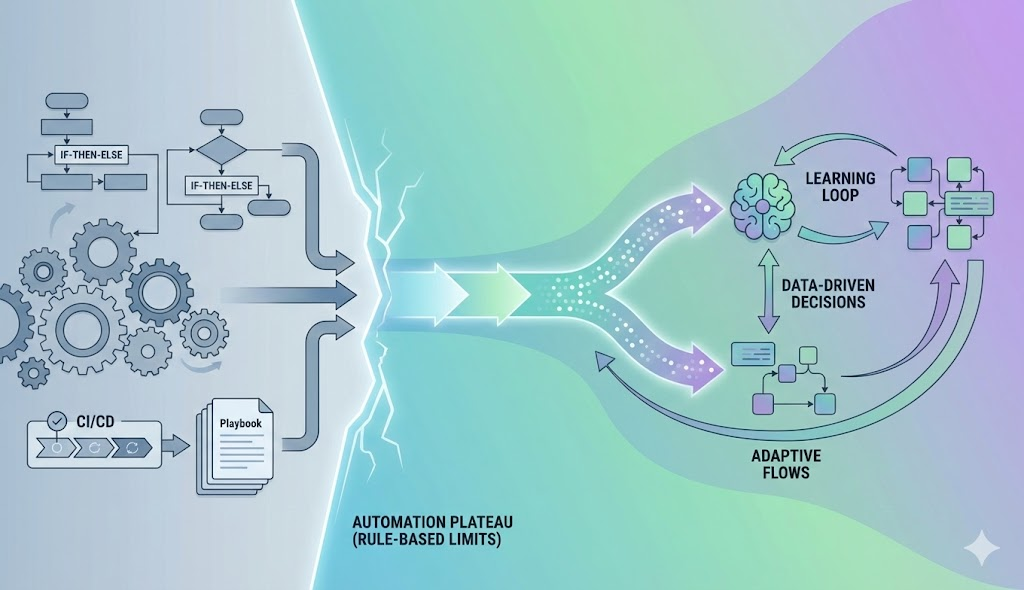
Why Automation Engineers Should Learn AI
(And What NOT to Learn First)
If you work in automation, you’re good at one thing:
Turning human decisions into repeatable systems.
For years, that meant:
- Eliminating manual work
- Enforcing consistency through rules
- Scaling infrastructure with scripts and IaC
But I kept hitting the same wall.
Modern systems are:
- Highly dynamic
- Driven by unpredictable user behavior
- Too complex for static rules
I’d write increasingly elaborate conditionals that still couldn’t handle edge cases. At some point,
More rules = more maintenance.
That’s when AI stopped being hype and started feeling necessary—not as a replacement, but as the next step in automation’s evolution.
1. Automation vs AI – The Real Difference
Strip away the hype:
Automation:
- Rule-based
- Deterministic
- Explicit logic you write
1
2
IF CPU > 70% for 5 minutes
THEN add 1 instance
AI:
- Data-driven
- Probabilistic
- Logic learned from historical behavior
1
2
Based on past traffic patterns,
predict load and scale before the spike happens
Mental model:
- Automation: “Do exactly what I tell you”
- AI: “Learn what usually works”
Automation executes known logic. AI handles unknown patterns.
2. Where Automation Reaches Its Limits
I’ve seen this pattern repeatedly:
- Auto-scaling rules that work in test but fail in production
- Alert floods with no prioritization
- Approval workflows treating all changes the same
- Self-service catalogs frozen in time
The fix? Add more rules.
1
2
3
4
5
Simple Automation
        ↓
Complex Rules
        ↓
Unmaintainable Mess
This isn’t bad design—it’s the natural limit of static logic.
3. Where AI Fits (Practically, Not Magically)
AI makes sense when:
- Rules are hard to define
- Patterns exist but aren’t obvious
- Decisions depend on historical behavior
Examples:
- Scaling: Predict load spikes instead of reacting to thresholds
- Incidents: Auto-classify severity based on past patterns
- Approvals: Risk-based routing instead of fixed rules
- Catalogs: Recommend resources based on usage history
AI augments decision-making. It doesn’t replace your IaC, CI/CD, or pipelines.
Tip: Start by looking for places where rules break down—AI is most valuable where automation hits its limits.
4. IaC/CI/CD vs AI – A Familiar Analogy
Infrastructure as Code (IaC)
Traditional approach:
1
2
3
4
resource "aws_instance" "web" {
  instance_type = "t3.medium"
  count         = 3
}
You declare everything explicitly.
AI-augmented:
1
2
Based on usage patterns and cost goals,
AI suggests optimal instance types and scaling thresholds.
CI/CD Pipelines
Traditional approach:
1
2
if: branch == 'main' && tests.passed()
  deploy: production
You define all the rules.
AI-augmented:
1
2
Based on past deployment failures,
AI predicts risk and suggests optimal deployment windows.
The Shift
1
2
IaC/CI/CD:  You maintain the rules
AI Addition: System learns from data
Both are needed. IaC/CI/CD provides control. AI handles complexity that’s too dynamic for static rules.
5. What You Do NOT Need to Learn First
Here’s what I wish someone had told me:
You do NOT need to start with:
- Linear algebra
- Probability theory
- Writing neural networks from scratch
- Academic ML research papers
That’s the data scientist path. It’s not yours (unless you want it to be).
6. What You Should Learn First
Focus on:
- Core ML concepts (not the math)
- Mental models (how learning systems behave)
- Where AI fits in real architectures
- How AI systems fail in production
Learning path:
1
2
Automation Foundations → ML Concepts → Deep Learning (Intuition)
  → Generative AI & LLMs → MLOps
7. What This Series Is (And Isn’t)
NOT:
- “Become a data scientist”
- Math-heavy tutorials
IS:
- AI explained using automation analogies
- Architecture-first thinking
- A reference for practitioners who build systems
What I Wish I Knew Earlier
Practitioner’s Lessons:
- AI is automation’s evolution, not its replacement
- AI starts where rules become unmaintainable
- You don’t need heavy math—you need architectural intuition
- Your automation background is an advantage
What’s Next?
How I’m approaching AI learning as an automation architect, what I’ll skip intentionally, and how I plan to connect AI back to real-world automation use cases.
This blog is both a learning journal and a practical reference—written for my future self and for anyone walking a similar path.