4. Code Refactoring Part 1
Refactoring Terraform code after import: best practices and workflow.
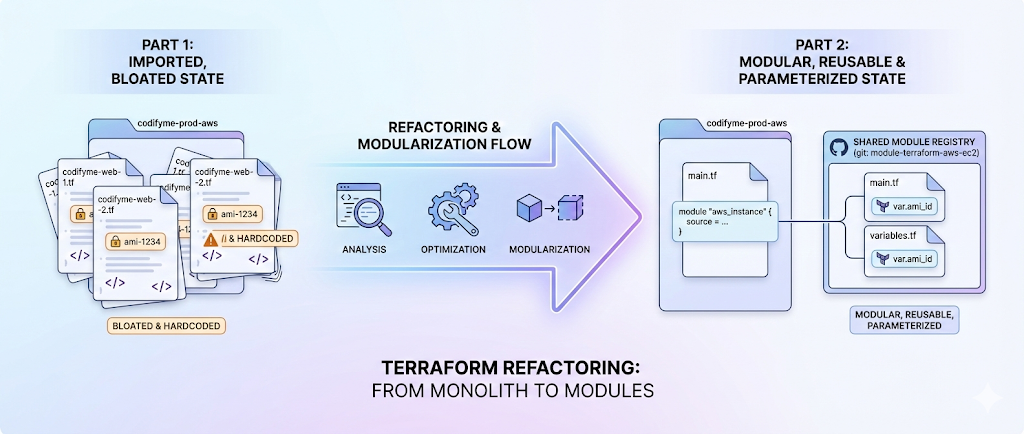
🧩 Code Refactoring: Enhancing Terraform Configurations
In the previous post, Terraform Import: Bringing Resources Under Control, we demonstrated how to import existing AWS EC2 resources into Terraform. We explored the step-by-step process of transitioning manually provisioned resources into Terraform-managed infrastructure, enabling better control and collaboration.
Now, we move to the next critical step: refactoring the imported Terraform code. Refactoring is essential to ensure that your Infrastructure as Code (IaC) remains scalable, maintainable, and reusable as your environment grows. Without proper refactoring, your Terraform configurations can become repetitive, difficult to manage, and prone to errors.
Why Refactoring Matters 🛠️

Refactoring Terraform code is not just about cleaning up configurations—it’s about enabling your infrastructure to scale efficiently while reducing operational overhead. Here’s why it’s crucial:
- Optimize Imported Resources: 🧹 Imported configurations often contain repetitive or hardcoded values, making them difficult to scale or reuse across environments.
- Support Multiple Environments: 🌍 Managing production and development environments with similar resources can lead to duplicated code and inconsistencies.
- Leverage Reusable Modules: 📦 While modules may already exist, they are often underutilized, leading to bloated root modules.
- Streamline Pipelines: 🚀 Integrating refactored code with CI/CD pipelines and GitOps workflows ensures automated, error-free deployments.
- Promote Best Practices: ✅ Refactoring enforces IaC principles like modularization, parameterization, and version control.
Key Challenges in the Current Setup ⚠️
Before diving into refactoring, let’s identify the common challenges in the current Terraform setup:
- Hardcoded Values: 🔒 Environment-specific configurations (e.g., AMI IDs, instance types) are hardcoded, reducing reusability.
- Code Duplication: 📄 Similar resources are defined separately for each environment, leading to inconsistencies.
- Lack of Modularity: 🧩 Root modules directly define resources instead of leveraging reusable modules.
- Pipeline Integration Issues: 🔄 Imported resources are not fully integrated into CI/CD pipelines, requiring manual interventions.
Goals of Refactoring 🎯
The primary goals of refactoring Terraform code are:
- Modularize Configurations: 🛠️ Use reusable modules for common resources (e.g., EC2, RDS, VPC) to eliminate duplication and improve consistency.
- Parameterize Inputs: 🔧 Replace hardcoded values with input variables to make the code environment-agnostic and reusable.
- Standardize Outputs: 📤 Define consistent outputs for modules to simplify integration with other modules or pipelines.
- Integrate with Pipelines: 🔄 Ensure the refactored code integrates seamlessly with CI/CD pipelines and GitOps workflows for automated deployments.
- Improve Maintainability: 📚 Organize the codebase to make it easier to navigate, review, and update.
What’s Next? 🚀
In the upcoming sections, we’ll walk through the process of refactoring Terraform code step by step. Here’s what we’ll cover:
- Analyzing the Current Codebase: 🔍
- Identify areas of improvement in the existing Terraform configurations.
- Creating Reusable Modules: 📦
- Refactor common resources into reusable modules with input variables and outputs.
- Parameterizing Root Modules: 🔧
- Replace hardcoded values in root modules with input variables to make them environment-agnostic.
- Validating and Testing: ✅
- Validate the refactored code using
terraform validateand test it in a staging environment before applying it to production.
- Validate the refactored code using
📝 Conclusion
Refactoring Terraform code is a critical step in the IaC journey. It ensures that your configurations are scalable, maintainable, and aligned with best practices. By modularizing resources, parameterizing inputs, and integrating with pipelines, you can streamline your infrastructure management and reduce operational overhead.
- In the next sections Code Refactoring: Enhancing Terraform Configurations (Part 2), we will dive into the practical steps of refactoring Terraform code, focusing on creating reusable modules and parameterizing inputs. Stay tuned for more insights and best practices! 🌟
Catch you later, code Ninjas! Happy Codifying! ⚙️💻🚀