Streamlining Application Infra Deployment: Foundations & Requirements
Why modern infrastructure deployment needs GitOps and IaC — real-world challenges, requirements, and foundational design principles.
💡 This series is written as a practitioner handbook — not theory.
Everything here is based on real-world platform engineering work across AWS, Azure, VMware, Terraform Enterprise, and enterprise DevOps pipelines.
What You’ll Learn
- Why traditional infrastructure delivery breaks at scale
- The real-world problems GitOps and IaC solve
- Core principles behind reliable infra automation
- How to frame your own modernization journey
1. Introduction — Why This Series Exists
🧭 Personal context:
Before working deeply with Infra as code(IAC), GitOps, and self-service cloud platforms, most of my automation efforts looked “successful” — pipelines ran, infra provisioned, tickets closed.But under the surface, things were fragile:
- Teams were afraid to touch infra code
- Rollbacks were painful
- Audits required detective work
- Every environment drifted differently
This series exists because working automation is not the same as operationally safe automation.
In today’s cloud-native world, infrastructure provisioning is no longer a one-time activity — it’s a continuous lifecycle problem. Environments must be:
- Reproducible
- Auditable
- Secure by default
- Cost-aware
- Recoverable
Traditional ticket-driven and script-heavy approaches simply don’t scale to this reality.
💬Core belief:
Infrastructure should behave like software — versioned, tested, reviewed, and deployed through pipelines
That belief is what drives GitOps, DevOps, and Infrastructure as Code (IaC).
1.1 What This Handbook Covers
This handbook walks through the complete lifecycle of modern infrastructure delivery — not just tooling, but operating model.
You’ll learn:
- Why traditional approaches fail
- How GitOps and IaC solve those failures
- What architecture patterns actually work at scale
- Where pipelines, policies, security, and cost controls fit
- How to operate this model across real enterprise teams
Unlike documentation that focuses on single tools, this guide focuses on systems thinking — pipelines, repos, controls, workflows, and humans.
1.2 How to Use This Series
📘 Think of this as a field manual, not a reference doc.
- Platform engineers → Use it to design foundations
- Cloud architects → Use it to validate governance models
- DevOps engineers → Use it to structure pipelines
- App teams → Use it to understand how infra delivery should work
Each chapter builds on the previous one:
flowchart LR
    A[Foundations & Requirements] --> B[Implementation & Tooling]
    B --> C[Advanced Practices & Adoption]
2. The Real Problem — Why Traditional Infra Delivery Breaks
⚠️ Hard truth: Most infrastructure failures are not tool failures — they are process failures.
Let’s anchor this in a real-world scenario.
2.1 Use Case — Modernizing Application Infra Delivery
Scenario: The Application team inside a Cloud Management Platform (CMP) organization manages the infrastructure for a business-critical application called todo_demoapp.
Over time, their delivery model evolved organically:
- Some infra created via scripts
- Some via tickets
- Some via manual console work
- Some via Terraform — inconsistently
Nothing was wrong individually — but together, the system became fragile.
🚨 Key Pain Points These are patterns I’ve seen repeatedly across enterprises — not theoretical issues.
- Fragmented collaboration: Dev, Ops, Security operate in silos; infra decisions happen outside code review
- Inconsistent provisioning: Every environment looks slightly different; no reliable way to reproduce failures
- Approval bottlenecks: Manual approvals for every infra change; no automated policy enforcement
- Security drift: Secrets leak into repos; compliance checks happen after deployment
- Low infra code confidence: Teams hesitate to touch Terraform or scripts; infra changes become “specialist-only”
- Lifecycle blind spots: No consistent decommissioning; zombie resources inflate costs
🎯 Objective The goal was to modernize infra delivery so that:
- Infra changes feel as safe as application changes
- Every change is reviewable, auditable, and reversible
- Environments remain consistent over time
- Security and compliance are enforced automatically
- Teams can self-serve infrastructure safely
And critically — the model must scale beyond just todo_demoapp.
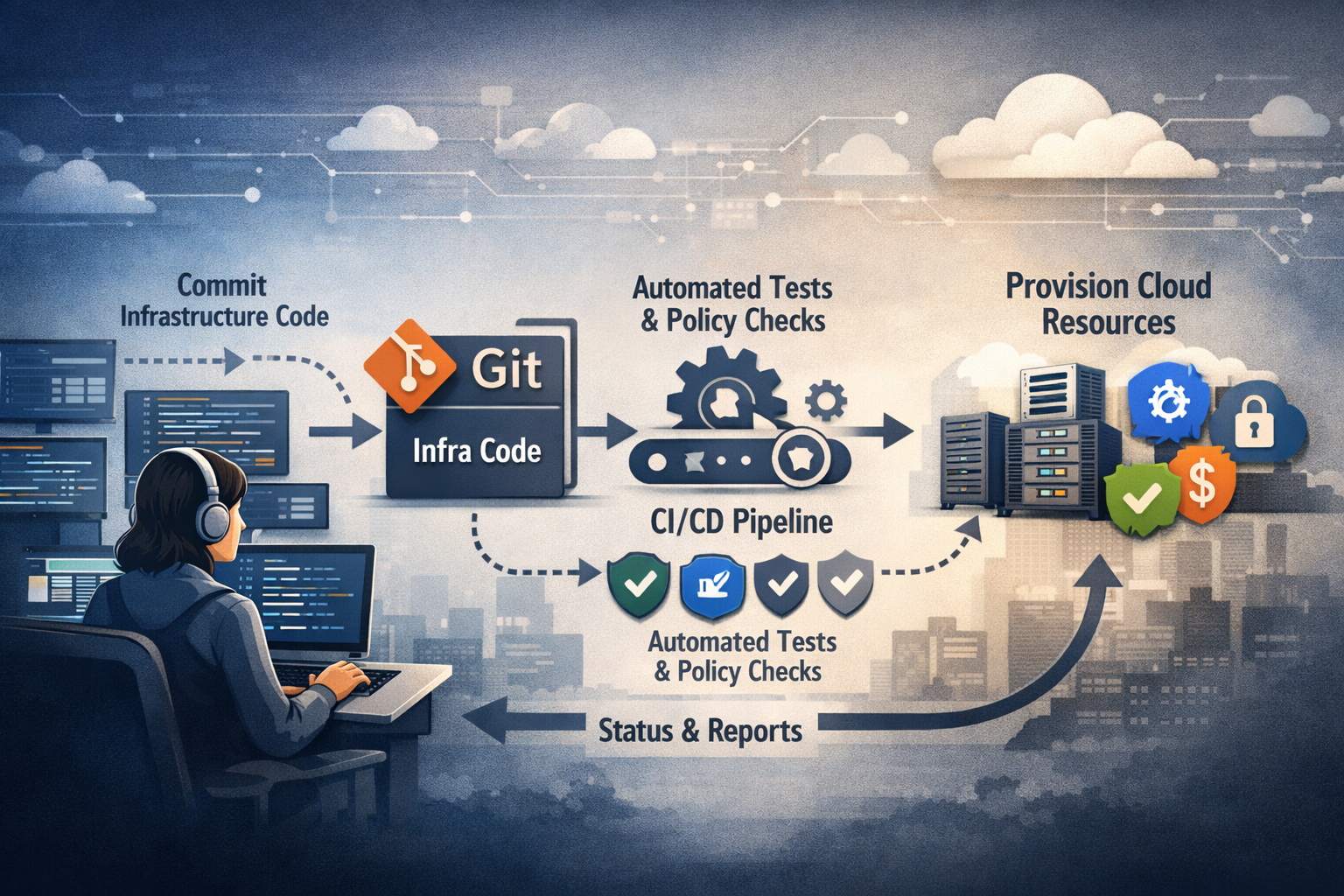
2.2 Target Operating Model (GitOps)
Here’s the desired mental model:
sequenceDiagram
    participant User as Developer
    participant Git as Git Repo
    participant CI as CI Pipeline
    participant Policy as Policy Engine
    participant Cloud as Cloud Platform

    User->>Git: Commit Infra Change
    Git->>CI: Trigger Pipeline
    CI->>Policy: Validate Security & Compliance
    Policy-->>CI: Pass/Fail
    CI->>Cloud: Apply Infrastructure
    Cloud-->>CI: Status
    CI-->>Git: Report Results
💡 Git becomes the control plane. No manual console work. No side scripts. No mystery state.
Everything flows from Git → Pipeline → Policy → Cloud.
3. Design & Implementation Principles
Before tooling, pipelines, or repositories — we need design principles. These principles act as guardrails for every architectural decision in the rest of this series.
3.1 Infrastructure as Code (IaC) Compliance
Infrastructure must be versioned, reviewable, and reproducible — or it’s not infrastructure, it’s configuration drift.
All infrastructure definitions must:
- Live in Git
- Support version history
- Be auditable
- Be deployable through pipelines
- Be immutable in design
No exceptions — including “temporary” resources.
3.2 Tool Standardization & Integration
Tool sprawl is a silent reliability killer. Standardizing on:
- Azure DevOps or similar (pipelines + repos)
- Terraform CLI
- Ansible
- CredScan / GitLeaks
- Infracost
…this allows:
- Consistent pipelines
- Predictable debugging
- Repeatable onboarding
- Organization-wide governance
Tools matter — but integration matters more.
3.3 Modular & Scalable Repository Design
Infrastructure code must scale across:
- Teams
- Applications
- Environments
- Cloud providers
This requires:
- Reusable core/child modules
- Thin root modules
- Clear environment separation
- Predictable naming conventions
You’ll see the full repo architecture in Part 2.
3.4 Continuous Security & Compliance
Security that happens after deployment is incident response — not security engineering.
Security must be:
- Shifted left
- Automated
- Non-optional
- Version-controlled
This means:
- Credential scanning
- IaC linting
- Policy-as-code enforcement
- Compliance validation in pipelines
Not in audits. Not in tickets. In pipelines.
3.5 Cost Awareness by Design
Cloud cost is an architectural property — not a billing problem.
Every infra change should expose:
- Cost deltas
- Resource impact
- Optimization opportunities
This requires cost estimation tools baked into pipelines — not quarterly FinOps reviews.
3.6 GitOps Automation via Webhooks
Humans should never be the deployment trigger. Git should be.
All deployments should originate from:
- Git commits
- Pull requests
- Merges
Webhooks trigger pipelines automatically — eliminating:
- Manual execution
- Drift
- Environment mismatch
3.7 Policy Enforcement & Idempotency
If a pipeline can succeed twice with different results, it is broken.
All deployments must be:
- Idempotent
- Deterministic
- Policy-governed
- Rollback-safe
Terraform and Ansible already support this — but only if designed intentionally.
4. How This Connects to the Rest of the Series
You’ve just learned:
- Why traditional infra delivery fails
- What principles modern platforms require
- How GitOps reframes infra as software delivery
Next:
👉 Part 2 — Implementation & Tooling We’ll translate these principles into:
- Real repo structures
- Pipeline templates
- Toolchains
- Module patterns
- Naming conventions
- CI/CD flows
And finally:
👉 Part 3 — Advanced Practices & Adoption We’ll cover:
- Webhook architecture
- Execution flow
- Policy engines
- Team onboarding
- Scaling GitOps across organizations
🚀 Call to Action Before moving to Part 2 — ask yourself:
- Where does infra drift exist today?
- Which changes bypass Git?
- What approvals are manual but could be policy-driven?
- Which environments can’t be reliably rebuilt?
Write these down — you’ll map them directly to solutions in the next chapter.